
Choosing fruit trees for your climate
How to choose fruit trees that suit your climate: chill hours, frost, summer heat, soil, rootstocks and pollination, plus a checklist before you buy.
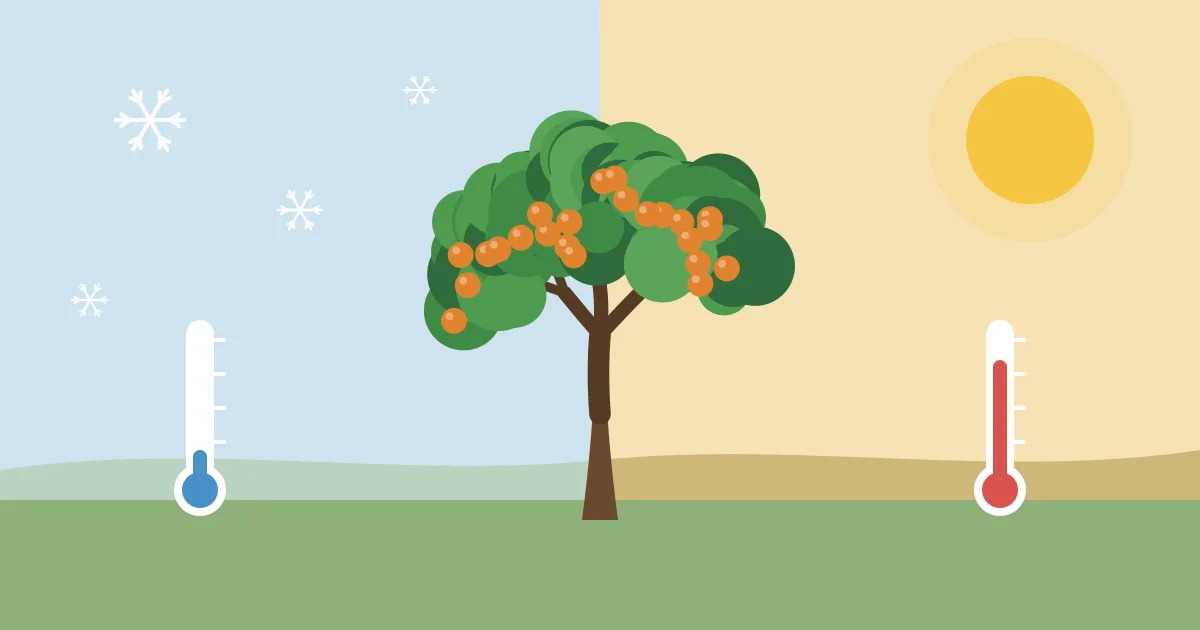
Most fruit trees that struggle were simply planted in the wrong place. Before you look at varieties, look at your own property: how cold it gets, how hot it gets, how much rain falls and when.
Know your chill
Deciduous fruit such as apples, pears, cherries, plums and peaches need a certain number of cold hours over winter (usually counted between about 0 and 7 °C) to flower and set fruit evenly. This is the tree's chill requirement.
- High chill (800 hours or more): most cherries, many apples and European pears. Suited to tablelands and cool inland areas.
- Medium chill (400 to 800 hours): many plums, apricots and some apples.
- Low chill (under 400 hours): low-chill peaches and nectarines, some apples bred for warmer areas.
A tree that doesn't get enough chill flowers late, patchily and over a long period, so the crop is light and ripens unevenly. Your local weather records or nursery can give you a rough chill figure for your district, and Trees n Bees counts chill hours for your own property from its local weather.
Frost and heat
Citrus, avocados, mangoes and other evergreens dislike frost, especially when young. Late spring frosts can also wipe out the blossom on early-flowering stone fruit. Cold air runs downhill and pools in low spots, so plant tender trees on slopes or near the top of a rise rather than in hollows.
Very hot, dry summers bring their own problems: sunburnt fruit and bark, and fruit drop when trees run short of water. Afternoon shade from a windbreak and reliable watering make a big difference.
Soil and water
Almost all fruit trees want free-draining soil. If water sits in a hole for more than a day after rain, plant on a raised mound or choose a rootstock suited to heavier ground. Ask your nursery which rootstock a tree is grafted on, as it affects vigour, size, drainage tolerance and resistance to some soil pests.
Short on space?
You don't need a big block to grow plenty of fruit. Trees grafted on dwarfing rootstocks stay around 2 to 3 metres, crop younger and are easy to net and pick from the ground. A multigraft (or fruit salad) tree carries two to five varieties of the same fruit family on one trunk, such as several plums, or a peach, nectarine and apricot together. It is a neat way to stretch the harvest over more weeks or to give a variety its pollination partner in one tree. Keep the stronger graft in check when pruning so it doesn't take over the weaker ones.
Pollination
Some fruit sets on its own (most peaches, nectarines, apricots, citrus and figs). Others need a second, compatible variety that flowers at the same time nearby, including many apples, pears, sweet cherries, Japanese plums and some avocados. Check the label or ask before buying a single tree.
A simple checklist before you buy
- What is my lowest winter temperature, and when is my last frost?
- Roughly how many chill hours do I get?
- How hot are my summers, and do I have water to get trees through them?
- Does the soil drain well?
- Does this variety need a pollination partner?
- How big will it grow on this rootstock?
Getting these right at the start saves years of disappointment. If you are planning a new block, the Trees n Bees orchard planner works out spacing for the tree size you choose and checks pollination partners before you order. Once the trees are in, each one keeps its variety and rootstock, and your property's chill hours and frosts build up beside its bloom dates, so you can see what really suits your place.