Orchard planning
Plan a new orchard before you dig
Trees n Bees helps small growers plan a new orchard in three steps: the land, what goes in, and a check. It works out the spacing and the grid, lays each variety out row by row, says whether each variety has a pollination partner, and gives you the list of trees to order. The plan becomes the orchard you record against.

The land
Enter the length and width of the ground, how big the trees should grow and how you get between the rows: on foot, a ride-on mower, a quad or buggy, or a small tractor. Trees n Bees works out the spacing between trees and between rows, and the grid of rows and trees that fits.
- Four tree sizes, from small trees picked from the ground on a dwarfing rootstock to full-size trees.
- Rows spaced for your machine between grown trees, not young ones.
- Every number can be changed, or type the rows and trees per row if you already know them.
What goes in
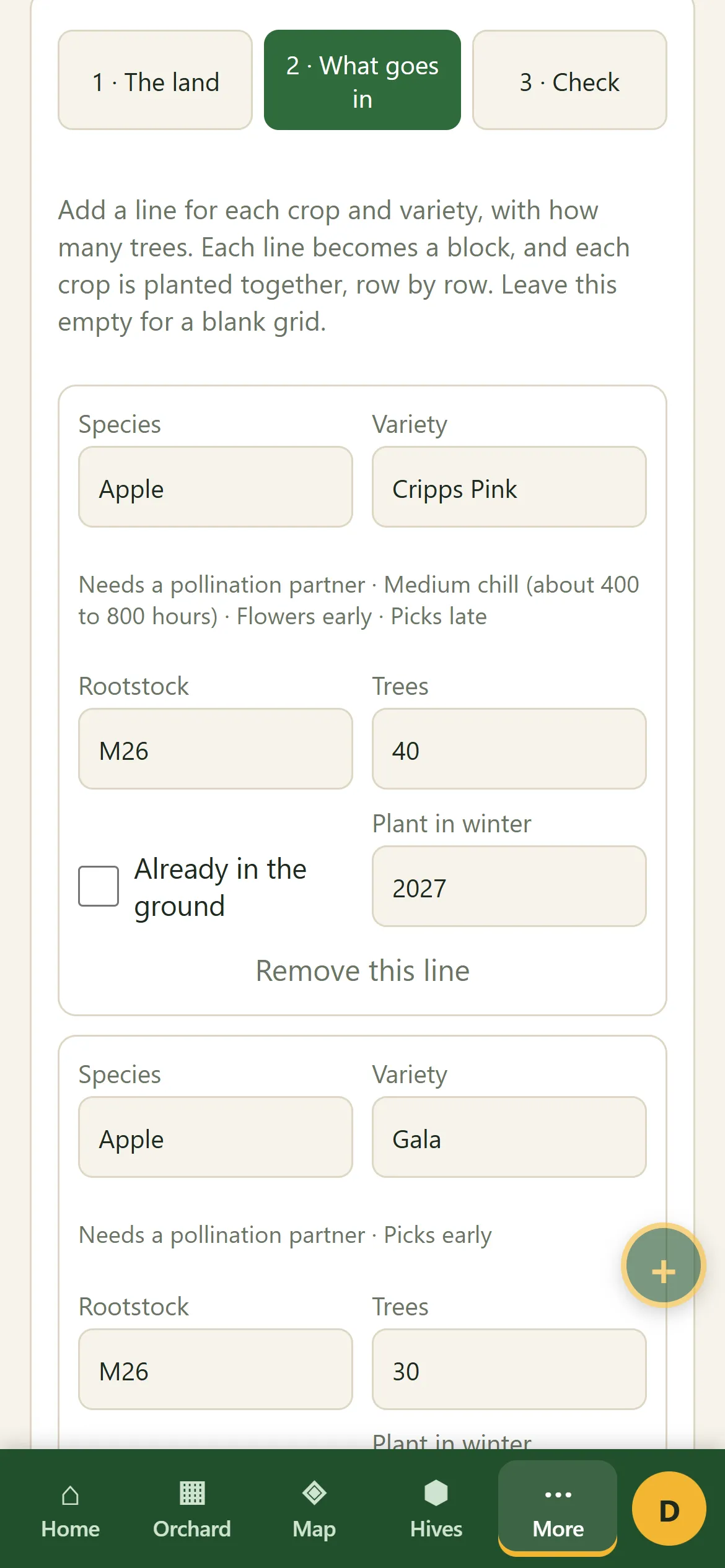
Add a line for each crop and variety, with a rootstock, how many trees and the winter you'll plant them, or mark them as already in the ground. Each crop is planted together, row by row, and each line becomes a block.
Crop, variety and rootstock names are suggested as you type, and a short line under each variety says whether it needs a partner, how much chill it needs, and when it flowers and is picked.
Pollination partners
For each variety that needs a partner, the check step says whether the plan has one, with the known partners to plant if it doesn't. Triploids need two partners; kiwifruit and pistachio need a male; avocados look for the other flower type; Japanese and European plums don't count for each other, nor do early and late flowering varieties. Self-fertile varieties need nothing.
Once the orchard is planted, each block and tree keeps showing whether its partners are in the same orchard, only in another orchard on the property, or missing.
Check the plan
- A dot picture of the orchard, each variety in its own colour.
- The planting stages, winter by winter.
- The trees to order, by winter, as a table and a CSV to send to your nursery.
- A plain list of what the plan does not check: your climate, frost and heat, the shape and slope of the ground, your soil, and flowering times in your district.
From plan to planted
Creating the orchard makes a block for each line, with its trees in place. Trees not in the ground yet are planned: dashed on the orchard grid and listed as the trees still to plant, with an order list to download. When they go in, mark a block's planned trees as planted on the date.
From there it's an ordinary orchard: record the work, bloom dates and harvests against each tree. More on orchard records →
Who it suits
Growers adding a new block or a new orchard, and anyone turning a paddock into fruit trees, who want the spacing, the varieties and the order list worked out together before the trees arrive. It is a starting point to talk over with your nursery, not a replacement for local advice.

Questions? See common questions, or the home page for everything Trees n Bees does.