Drip irrigation for fruit trees, made simple
How to set up drip irrigation for fruit trees: drippers and inline pipe, where to put them, how long to run them, timers, filters and upkeep.
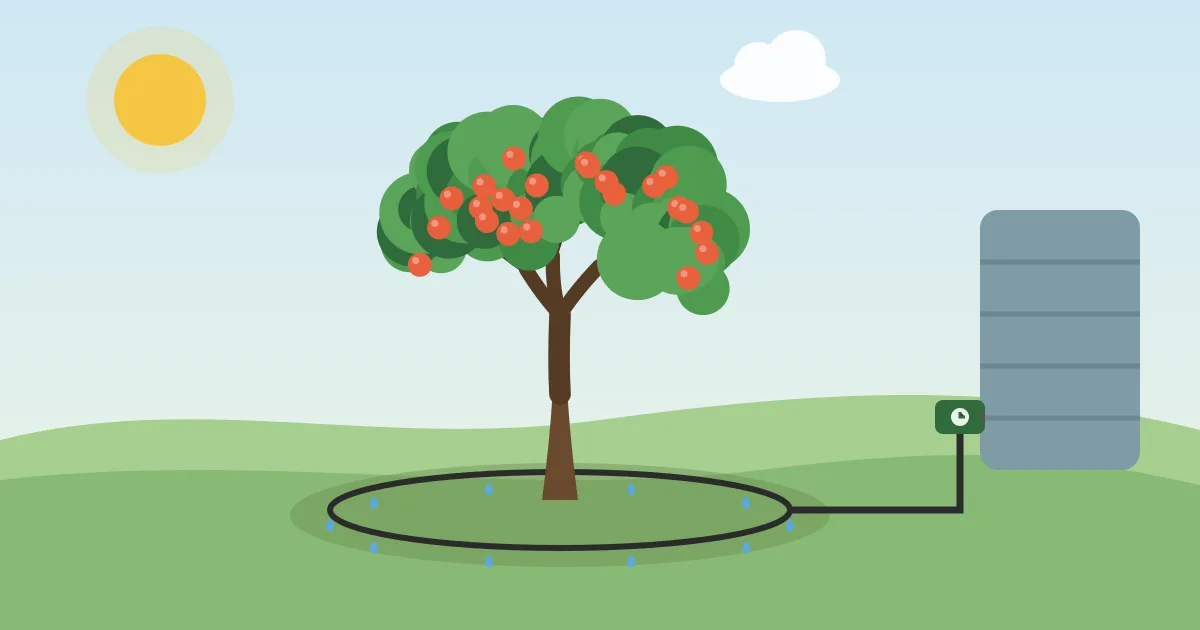
Drip irrigation puts water right where the roots are, slowly, with very little lost to evaporation or runoff. Once set up, it saves hours of hand watering every summer, and it is easy to do yourself.
What you need
- A filter at the start, so grit doesn't block the drippers. Essential with tank or bore water.
- A pressure reducer, as most drip systems run best at lower pressure than mains water.
- Main line: 13 to 19 mm poly pipe running along the row.
- Drippers: either button drippers punched into the pipe, or inline drip pipe with drippers built in every 30 cm or so.
- A timer, battery or tap-mounted, so watering happens even when you are away.
- Joiners, end plugs and stakes to hold it all in place.
Pressure-compensating drippers give the same flow along the whole line, which matters on slopes and long runs.
Where to put the drippers
The feeding roots of a fruit tree are spread out under the canopy and beyond, not at the trunk. Run a ring of drip pipe or drippers around each tree, about halfway to the edge of the canopy for young trees, and move or extend it outwards as the tree grows. Mulch over the top to slow evaporation and keep the pipe out of the sun.
How long to run it
Work out how much water each tree gets per hour, then run the system long enough to wet the soil deeply.
Example: 8 drippers at 4 litres an hour give 32 litres an hour. Two hours gives the tree 64 litres.
- Run it less often but for longer, so water soaks down 40 to 60 cm.
- Water in the early morning.
- Check by digging down with a trowel a few hours later. The soil should be moist well below the surface.
- Increase run times in heatwaves and when fruit is swelling; cut back after rain and in cooler months.
Keeping it working
- Flush the lines at the start of each season by opening the end plugs and running water through.
- Clean the filter regularly.
- Walk the lines while they run and look for dry spots, blocked drippers and leaks. Birds and rabbits sometimes chew the pipe.
- Replace timer batteries before summer.
Using tank water
Drip irrigation works well on tank water, as it uses so little. Gravity-fed systems need a tank set well above the trees, or a small pump; low-pressure drippers suit them best.
Trees n Bees keeps your tank levels and water use, and shows how many days of water are left at your current rate, alongside the rainfall for your property. A dry spell alert tells you when it's time to turn the timer up.